How does the Pocket 2 perform in completely dark environments, such as unlit cellars or underground spaces? Specifically, how do point clouds hold up when visual features are limited, and how do the RGB cameras handle pitch black or low-light conditions?
Hi antoine.I, the LiDAR sensor will still deliver the accurate point cloud, but it won’t be colourized, the RGB cameras will deliver no information.
When scanning in complete darkness, the mobile LiDAR scanner will still function and generate precise 3D data.
LiDAR is an active sensor system that emits its own infrared laser pulses and measures the return time, meaning it requires zero ambient light to map geometric space. However, without useful camera data, the color information will be lost or pitch black.
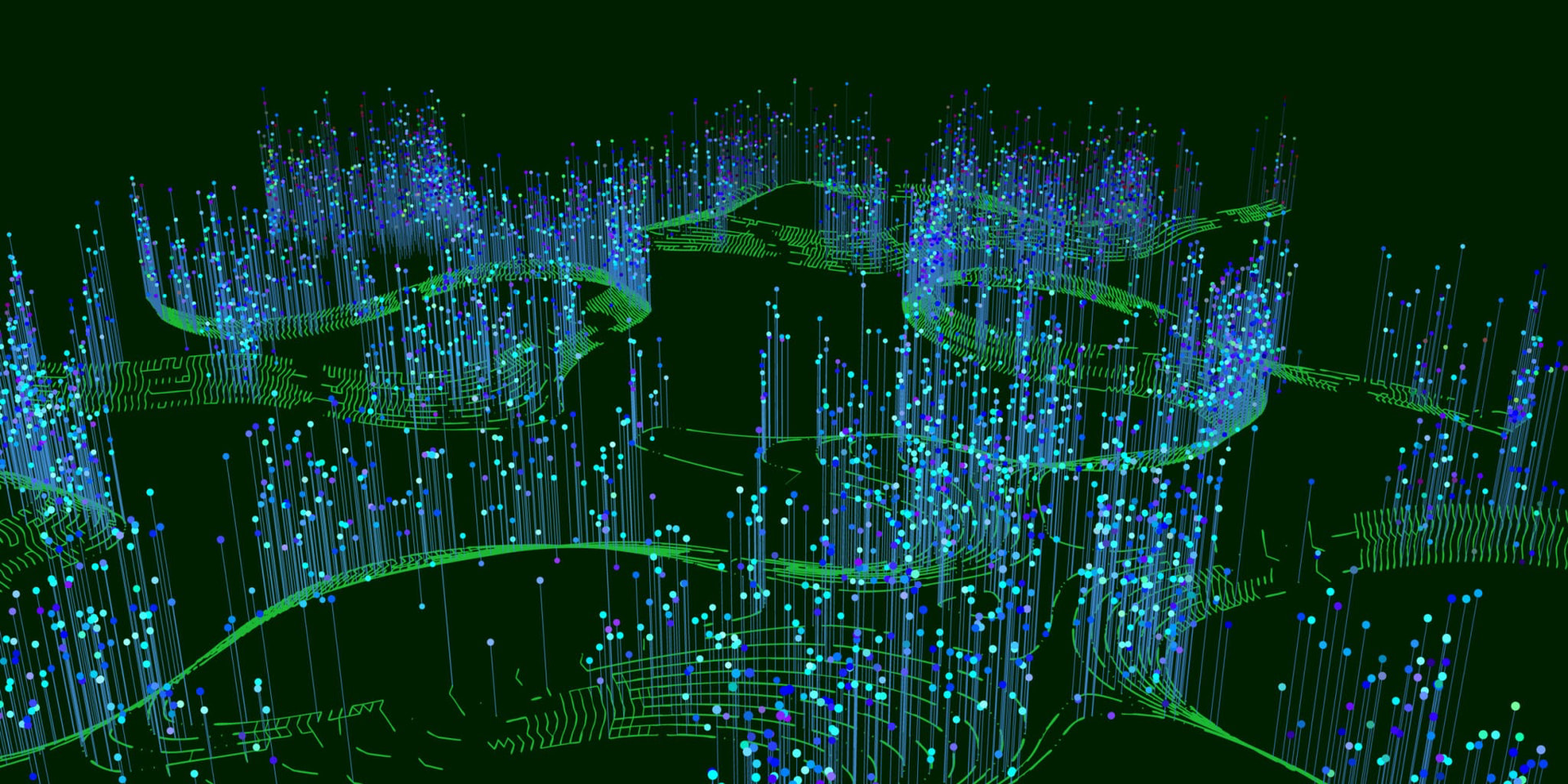
What You Can Still Achieve
-
Accurate 3D Geometry: Generate a dimensionally accurate 3D point cloud, mesh, or floor plan of the room down to millimeter or centimeter accuracy.
-
LiDAR Intensity Value Mapping: View point clouds colored by laser return intensity (reflectivity). This distinguishes between materials (e.g., metal, wood, paint) or reads high-contrast objects like road lines and signs even without photorealistic RGB.
-
Elevation & Height Maps: Color-code points by their height ($Z$-coordinate) to easily visualize floors, ceilings, walls, and obstacle clearances.
-
SLAM Trajectory Tracking: Maintain trajectory mapping if the scanner relies primarily on LiDAR-Inertial SLAM (LIO-SLAM), which pairs laser geometry with an Inertial Measurement Unit (IMU).
What Is Lost or Compromised
-
RGB Colorization: You will not get photorealistic textures, true color overlays, or visual panorama photos.
-
Visual SLAM Drift Correction: If your device uses Visual SLAM (using RGB cameras for feature tracking alongside LiDAR), position estimation may drift or fail entirely due to losing visual tracking features.
-
Photogrammetry Fusion: Automatic visual feature detection, boundary classification, and automated object recognition models trained strictly on RGB image data will fail.
Workarounds & Solutions
-
Mount On-Board Lighting: Attach continuous LED illumination (like a LED panel or spotlight) to the scanner rig to restore RGB camera capture.
-
Intensity-Based Processing: Rely on point reflectivity algorithms rather than color thresholds for segmentation tasks.
-
Post-Processing Colorization: Align and project high-resolution flash photos or thermal imagery onto the geometry later during post-processing.
Yeah so I’ve actually taken this thing down into a couple of pitch-black basements and honestly? The 3D scanning part works totally fine in the dark — it’s got its own laser so it doesn’t need any light at all, the point clouds come out just as clean as when the lights are on. The tracking doesn’t freak out either 'cause it’s using the LiDAR to figure out where it is, not the cameras. Only thing is if you want color on your scan, the RGB cameras can’t see jack in complete darkness, so you’ll wanna throw on a headlamp or hold up a phone flashlight or something while you scan. Other than that? Dark spaces are no problem at all. The specs are on their site if you wanna check — Manifold Pocket2 | Manifold Tech — and they even list underground mine surveying as a use case over here: Digital Assets | Manifold Tech